
And How To Spot Them…
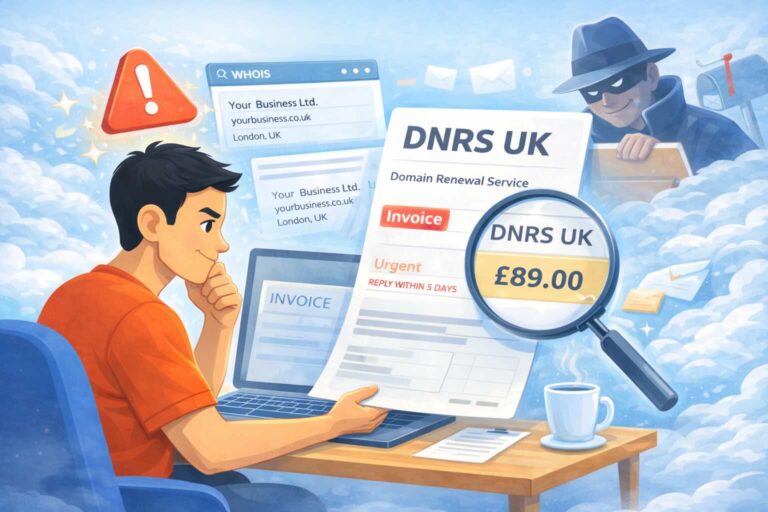
If you own a domain name for your business, there’s a good chance you’ve received – or will receive – an email that looks like an urgent invoice for your domain renewal.
It knows your company name, your address, your domain.
It looks official.
It asks for money.
It’s a scam.
The DNRS UK Scam: A Recent Example
A well-documented example doing the rounds right now is DNRS UK (operating from dnrsuk.com). They’ve been sending emails to UK businesses requesting £89 for a so-called “domain renewal notification service.” The email is polished, uses real details scraped from public records like WHOIS and Companies House, and even includes a fake invoice with a 5-day deadline.
Scam investigator Olly has exposed the operation in detail, revealing it as part of an international franchise of the same scam that has previously targeted businesses in Australia and New Zealand under different names.
The product they’re selling – a “renewal notification service” – simply does not exist.
How to Spot a Fake Domain Renewal Email
These scams are getting more convincing, but the warning signs are always there if you know what to look for.
The sender isn’t your registrar. Your domain renewal reminders come from whoever you registered your domain with – and nowhere else. If the email is from a company you’ve never heard of, that’s your first red flag.
The price is wildly inflated. A typical UK domain renewal costs £8 to £12 a year. If someone is asking for £89, something is very wrong.
They use urgency and silence tactics. Phrases like “reply within 5 days or we’ll assume you wish to continue” are designed to panic you into paying. You cannot be enrolled into a paid contract by simply not replying to an unsolicited email – that’s not how UK contract law works.
They know your details, but that doesn’t make them legitimate. Your company name, address, and domain are all publicly available on Companies House and WHOIS lookups. Scammers scrape this data to make their emails look credible.
The name sounds official but means nothing. “DNRS” is designed to sound like something to do with DNS or Nominet. It isn’t. It’s a made-up acronym chosen to make you hesitate before deleting it.
What to Do If You Get One
- Do not pay. The service being sold is fictitious.
- Do not reply. Replying confirms your email address is active and invites more scam mail.
- Do not click any links in the email.
- Check your actual domain directly – log into your real registrar or contact your hosting provider to confirm your renewal status.
- Report it to Action Fraud at actionfraud.police.uk and forward it to report@phishing.gov.uk.
- Warn your team – accounts departments are the usual target, so make sure colleagues know to flag anything like this before acting on it.
We Can Help You Stay Safe
At The Very Good Email Company, we manage domains and email hosting for businesses across the UK – and we’re always on hand when something doesn’t look right.
If you’re a customer and you receive an unexpected email about your domain or email services, just ask us before paying anything. We can confirm in moments whether a renewal notice is genuine, or whether it belongs in the bin.
We’ve also written an article on Too Good to Be Fake: How AI Is Making Spam and Scams Harder to Spot – which includes some useful tips.
Our services include built-in anti-spam and anti-virus filtering as standard, which catches a lot of this kind of thing before it even reaches your inbox. And because we look after your domain, email, and website in one place, you’ll always know exactly who to contact if something looks suspicious.
If you’re not yet a customer but you’re tired of navigating anonymous support lines at the big platforms, we’d love to hear from you.
The DNRS UK scam is documented in full by scam investigator Olly at 0lly.uk.