
What’s Changed, What’s Broken,
and What You Can Actually Do About It.
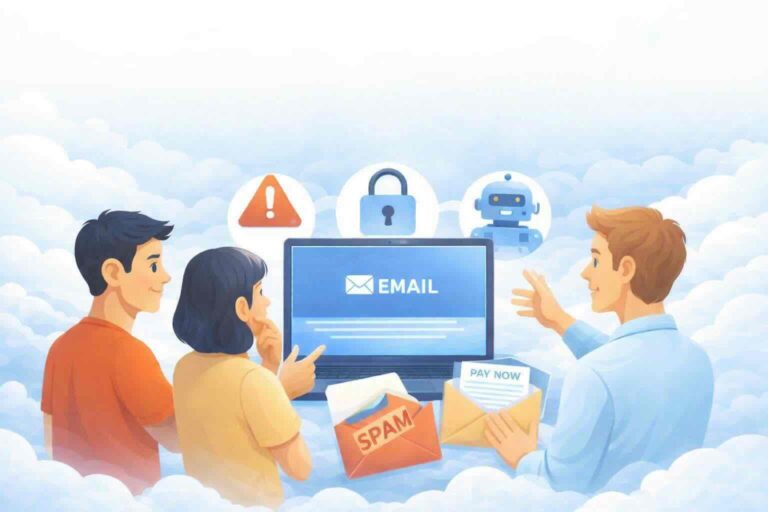
Email is older than most of the people using it, and somehow it’s never been more important.
It’s still where your invoices land, where your bank confirms a payment, where a new customer first reaches out, and where the password reset for almost every other service in your life is sent.
Lose access to your email and you lose access to a startling amount of your digital identity.
And yet, for many people and small businesses in 2026, the everyday experience of email is quietly getting worse. Inboxes are noisier. Legitimate messages are disappearing into spam. Accounts are being suspended without warning. And the “free” mailboxes most of us grew up on are turning out to have a price after all.
Here’s a look at what’s actually going on – and some practical things you can do about it.
1.Your email is training someone else’s AI
Over the past couple of years, the big consumer email platforms have quietly expanded what they do with the contents of your mailbox. Scanning for spam and malware is one thing – most people understand that has to happen. But scanning to personalise ads, to feed “smart” features, and increasingly to train AI models is a different conversation, and one most users were never really invited to.
Even where opt-outs exist, they’re often buried, change frequently, or apply only to some products. The practical effect is that if you’re using a free consumer mailbox for personal or business correspondence, you should assume the contents are being read by something, somewhere, for purposes beyond simply delivering your mail.
What you can do: use an email provider whose business model is “you pay us a small amount of money to host your email” rather than “we get to look at your email.” It’s a much simpler relationship.
2.The AI generated spam tsunami
Spam used to be easy to spot. Misspelt words, dodgy grammar, a Nigerian prince. In 2026, generative AI has made cold outreach, phishing, and fraud uncomfortably polished. The message asking you to “confirm your invoice” now reads like it was written by a competent human, references your real company, and arrives from a domain that looks almost right.
Two things are making this worse at once: the volume of plausible-looking junk is rising fast, and the underlying filters have to be more cautious about blocking things, because legitimate senders are increasingly using AI to draft their messages too.
What you can do: filtering quality matters more than it ever did. Look for a provider that takes anti-spam and anti-virus seriously as a core service, not as a checkbox. And get into the habit of verifying anything that asks you to click, pay, or log in – by going to the site yourself, not via the email.
3.Deliverability is harder than ever
If you send email from your own domain – for your business, your charity, your newsletter – you’ve probably noticed that getting messages reliably into people’s inboxes has become a small science project. SPF, DKIM, DMARC alignment, reputation, sending limits… the rules tightened significantly in 2024 and have kept tightening since.
Get any of it wrong and your invoices end up in spam, or worse, bounce. Small businesses sending from a generic free account, or from a hastily-configured domain, are being hit hardest.
What you can do: send from your own domain, and make sure whoever is hosting that email actually understands modern deliverability and can configure it for you. This is one of the areas where having a real human on the end of a phone genuinely matters.
4.When your provider locks you out, you’re on your own
This is the one that catches people out hardest. There are now years of stories from people whose Gmail or Outlook accounts were suspended – sometimes for a violation they didn’t commit, sometimes for no reason anyone will explain – and who then discovered that “support” for a free account means a help page and a form that never gets answered.
If your email address is hosted on a free consumer platform, and that platform decides to lock the account, you can lose your address, your archive, and the keys to every other service that uses that email to log in. Recovery is often described in the news; it’s rarely described as fast.
What you can do: use an address on a domain you actually own, hosted with a provider that has real, contactable support. If you ever need to move, you take your address with you.
5. “Free” email isn’t free for business use
Beyond privacy, free consumer email costs small businesses in subtler ways. An @gmail or @hotmail address looks unprofessional on a quote. It makes it harder for customers to trust who they’re dealing with. It tangles personal and business correspondence in the same mailbox. And it usually means no archiving, no admin controls, no compliance story when a regulator asks.
What you can do: a proper business mailbox on your own domain – with shared calendars, contacts, archiving, and decent filtering – is one of the cheapest upgrades a small business can make. The monthly cost is typically less than a couple of coffees per user.
Where we come in
We’re The Very Good Email Company – a UK-based business that does one thing: email – along with the domain hosting, filtering, marketing, archiving, and WordPress websites that sit behind it all. Our network and our support team are both based in the UK, so when you call, you get a real person who knows the system, not a script in a distant call centre.
If any of the issues above sound like ones you’re living with – inbox overload, mystery deliverability problems, an account you’re nervous about losing, or simply wanting your email somewhere you can actually trust – we’d be glad to talk it through. We help with successful migrations, from the big platforms, all the time, and we can usually tell you in a short conversation whether moving is worth it for your situation.
The bottom line…
Email isn’t broken. But the experience of using it has drifted, slowly, in a direction that suits the platforms more than the people sending and receiving the messages.
The good news is that it doesn’t have to be that way: own your domain, choose a provider whose business is email rather than advertising, and make sure there’s a human you can talk to when something goes wrong.
The underlying technology is as solid as it ever was – you just need to be on the right side of it.